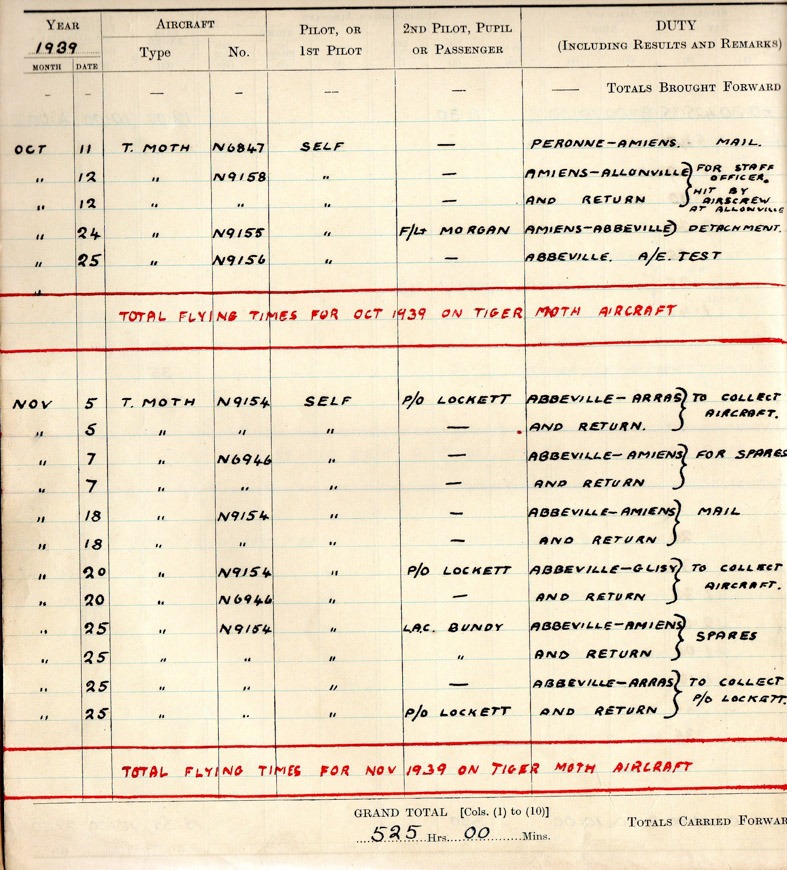
‘EI was initially based at Squadron HQ at Amiens Montjoie, but, in November 1939, was detached with Pilot Officer Peter Lockett to 51 Wing, initially at Abbeville and, from April 1940, at Dieppe St Aubin.
G-AOEI – History
G-AOEI was built for the RAF by de Havilland at Hatfield and delivered in the summer of 1939.
On the outbreak of War, EI’s first deployment was with 81 (Communications) Squadron in Northern France. The Squadron provided support to the Air Component of the British Expeditionary Force by taking personnel, messages and supplies wherever they were needed. It was the only RAF Squadron to be equipped almost exclusively with Tiger Moths.
EI was initially based at Squadron HQ at Amiens Montjoie, but, in November 1939, was detached with Pilot Officer Peter Lockett to 51 Wing, initially at Abbeville and, from April 1940, at Dieppe St Aubin.
During their six months together, Peter accumulated more hours on EI than any other wartime pilot. Among their shared adventures was a forced landing in a field due to fog, scouting locations where new airfields could be built for the RAF and ferrying a Chaplain to his Sunday services.
For the six months after the Dunkirk evacuation, EI’s whereabouts are something of a mystery. It seems possible that EI became a prototype for the use of Tiger Moths as emergency anti-invasion bombers as part of “Operation Banquet Lights”. The operation was so desperate that it was surrounded by great secrecy and pilots were required not to log flights where bombing was practiced using bricks. The remains of EI’s bombing equipment were found by EI’s first civilian owner, Flying Officer Malcolm Freestone, when he took delivery of EI from the RAF in 1955, including the bomb release gear in the rear cockpit, cable runs and rack attachment points outboard of the undercarriage.
From October 1940, EI was based at Hendon and for the next two months became heavily involved in training 28 members of the Czech Reserve who had been posted to 24 (Communications) Squadron to gain familiarity with the wide range of British types it operated.
EI remained with Communications Squadrons at Hendon until being sent to storage in October 1944. EI’s main role at this time was to provide currency flights and a self-drive taxi service to Staff Officers, many quite senior, most of whom were undertaking desk tours in London.
The most senior officer known to have flown EI at this time was Air Chief Marshal Sir Guy Garrod who, at the time, was the Member of the Air Council with overall responsibility for training. EI’s reluctance to start on his final EI flight home from Netheravon, where Garrod had been watching a demonstration of airborne forces, was noted in his logbook.
The highest-timed EI pilot during the Hendon period was one of the Czech instructors, František Altman, who earned an AFC for flying VIPs, including Winston Churchill, and is said to have been Lord Trenchard’s first choice for communications flights.
The other Czech instructor who flew EI, Alois Vrecl, was a pioneer of Czechoslovak aviation and had the most colourful aviation career of all EI’s known wartime pilots. He had flown for the other side during World War One, claiming three combat victories over Russian aircraft.